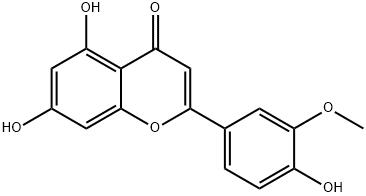
Catalog Number
ANC02081
Product Name
Chrysoeriol
Structure
Chrysoeriol
CAS Number
491-71-4
IUPAC Name
5,7-dihydroxy-2-(4-hydroxy-3-methoxyphenyl)chromen-4-one
Synonyms
1.5,7-Dihydroxy-2-(4-hydroxy-3-methoxyphenyl)-4-benzopyrone
Molecular Formula
C16H12O6
Molecular Weight
300.27
Appearance
Yellow Powder
Purity
98%
Description
Chrysoeriol is a flavonoid that has been found in Capsicum and has diverse biological activities. It is active against the Gram-positive bacteria E. faecalis, B. subtilis, and S. aureus (MICs = 1, 1, and 0.25 µg/ml, respectively) and the Gram-negative bacteria P. aeruginosa, K. pneumoniae, and E. coli (MICs = 0.12, 0.25, and 0.06 µg/ml, respectively). Chrysoeriol (7.5, 15, and 30 µM) induces cell cycle arrest at the G1 phase and autophagy in A549 lung cancer cells. It reduces LPS-induced production of IL-6, IL-1β, and TNF-α in RAW 264.7 cells when used at a concentration of 20 µM. Chrysoeriol (20 mg/kg) reduces plasma glucose, total cholesterol, free fatty acid, and phospholipid levels in a rat model of diabetes induced by streptozotocin (STZ; ). Chrysoeriol analytical standard provided with w/w absolute assay, to be used for quantitative titration. Chrysoeriol, also known as scoparol, belongs to the class of organic compounds known as 3'-o-methylated flavonoids. These are flavonoids with methoxy groups attached to the C3' atom of the flavonoid backbone. Thus, chrysoeriol is considered to be a flavonoid lipid molecule. Chrysoeriol exists as a solid and is considered to be practically insoluble (in water) and relatively neutral. Within the cell, chrysoeriol is primarily located in the membrane (predicted from logP). Chrysoeriol participates in a number of enzymatic reactions. In particular, chrysoeriol can be biosynthesized from luteolin. Chrysoeriol is also a parent compound for other transformation products, including but not limited to, 7-O-(6-p-coumaroylglucosyl)chrysoeriol, 7-O-[alpha-L-rhamnosyl-(1->2)-beta-D-glucosyl]chrysoeriol, and geraldone. Chrysoeriol is a bitter tasting compound that can be found in a number of food items such as common sage, alfalfa, corn, and tarragon. This makes chrysoeriol a potential biomarker for the consumption of these food products. 4',5,7-trihydroxy-3'-methoxyflavone is the 3'-O-methyl derivative of luteolin. It has a role as an antineoplastic agent, an antioxidant and a metabolite. It is a trihydroxyflavone and a monomethoxyflavone. It derives from a luteolin. It is a conjugate acid of a 4',5-dihydroxy-3'-methoxyflavon-7-olate(1-).
SMILES
COC1=C(C=CC(=C1)C2=CC(=O)C3=C(C=C(C=C3O2)O)O)O
InChI
InChI=1S/C16H12O6/c1-21-14-4-8(2-3-10(14)18)13-7-12(20)16-11(19)5-9(17)6-15(16)22-13/h2-7,17-19H,1H3
InChI Key
SCZVLDHREVKTSH-UHFFFAOYSA-N
Inquiry

new products