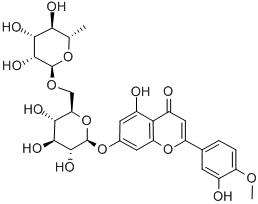
Catalog Number
ANC01954
Product Name
Diosmin
Structure
Diosmin
CAS Number
520-27-4
IUPAC Name
5-hydroxy-2-(3-hydroxy-4-methoxyphenyl)-7-[(2S,3R,4S,5S,6R)-3,4,5-trihydroxy-6-[[(2R,3R,4R,5R,6S)-3,4,5-trihydroxy-6-methyloxan-2-yl]oxymethyl]oxan-2-yl]oxychromen-4-one
Synonyms
7-[6-O-Deoxy-a-L-mannopyranosyl)-b-D-glucopyranosyl)oxy]-5-hydroxy-2-(3-hydroxy-4-methoxyphenyl)-4H-1-benzopyran-4-one; 3',5,7-Trihydroxy-4'-methoxyflavone7-rutinoside; Diosmetin7-b-rutinoside
Molecular Formula
C28H32O15
Molecular Weight
608.54
Appearance
Yellow Powder
Purity
≥98%
Melting Point
>266°C
Description
Diosmin was separated from the root of Scrophularia nodosa L.玄参 in 1925. The root of Scrophularia nodosa L. 玄参has the function of nourishing, reducing fever, relieving internal heat, and detoxicating. It was firstly recorded in the Shen Nong’s Classic of Materia Medica, as a class of middle-grade drug and is currently recorded in the Ch.P 2015, Volume I. The natural resource was abundant in China, mainly provided from Zhejiang, Sichuan, Hubei, Anhui, and Jiangsu provinces. In the clinical practice, Scrophularia nodosa L.玄参 was employed to eliminate pathogenic heat from the blood. In the clinical indication, it was mainly applied to treat fever, polydipsia, maculitis, gingivitis, amygdalitis, laryngopharyngitis, acute lymphadenitis, etc. It also has the biological function of antiplatelet aggregation and antitumor. The chemical components include iridoids, phenylpropanoid glycoside, flavonoids, and fatty acids.
SMILES
C[C@H]1[C@@H]([C@H]([C@H]([C@@H](O1)OC[C@@H]2[C@H]([C@@H]([C@H]([C@@H](O2)OC3=CC(=C4C(=C3)OC(=CC4=O)C5=CC(=C(C=C5)OC)O)O)O)O)O)O)O)O
InChI
InChI=1S/C28H32O15/c1-10-21(32)23(34)25(36)27(40-10)39-9-19-22(33)24(35)26(37)28(43-19)41-12-6-14(30)20-15(31)8-17(42-18(20)7-12)11-3-4-16(38-2)13(29)5-11/h3-8,10,19,21-30,32-37H,9H2,1-2H3/t10-,19+,21-,22+,23+,24-,25+,26+,27+,28+/m0/s1
InChI Key
GZSOSUNBTXMUFQ-YFAPSIMESA-N
Inquiry

new products